Comparison of Phosphoric Acid Production Process Methods
In the dynamic world of chemical manufacturing, the production of phosphoric acid plays a pivotal role in various industries, from agriculture and food processing to pharmaceuticals and environmental management. As a critical component in the production of fertilizers, detergents, and specialty chemicals, phosphoric acid‘s production methods significantly impact both cost and quality. Understanding the nuances of different production techniques is essential for optimizing efficiency and achieving high-purity outputs. This document delves into a comparative analysis of three primary methods for phosphoric acid production—the wet process, thermal process, and electrothermal process. By examining each method’s advantages, drawbacks, and chemical reactions, we aim to provide insights that can guide commercial decisions and enhance industrial operations.
Wet Process
Overview: The wet process is the most widely used method for producing phosphoric acid. It involves the reaction of phosphate rock with sulfuric acid to produce phosphoric acid and gypsum as a byproduct.
Process:
Reaction: Phosphate rock (Ca3(PO4)2) is reacted with sulfuric acid (H2SO4).
Chemical Reaction:
(Phosphate rock + Sulfuric acid → Phosphoric acid + Gypsum)
Separation: Phosphoric acid is separated from the gypsum by filtration.
Purification: The phosphoric acid is then concentrated and purified.

Thermal Process
Overview: The thermal process involves the reaction of phosphate rock with coke and silica at high temperatures in an electric furnace. This process produces phosphorus and phosphoric acid.
Process:
Reaction: Phosphate rock (Ca3(PO4)2), coke (C), and silica (SiO2) are heated in an electric furnace.
Chemical Reaction:
(Phosphate rock + Coke + Silica → Phosphoric acid + Carbon monoxide + Calcium silicate)
Formation: Phosphorus is volatilized and absorbed into a water-cooled condenser to form phosphoric acid.

Summary
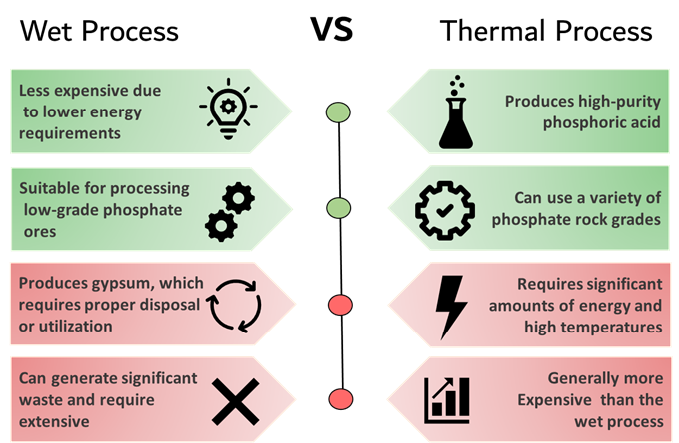
- Wet Process: Most common and cost-effective but produces gypsum as a byproduct.
- Thermal Process: Produces high-purity phosphoric acid but is energy-intensive and costly.