Introduction:
Antiscalants are chemical additives used primarily in water treatment, particularly in industries where scale formation can impede operations, such as in cooling towers, boilers, and reverse osmosis systems. They help prevent the formation and deposition of scale, which consists of mineral deposits like calcium carbonate, calcium sulfate, and magnesium silicate.
They work through two main mechanisms:
- Scale Dissolution:
Antiscalants can aid in the dissolution of existing scale deposits. This mechanism involves the chelation or dispersion of scale-forming minerals (like calcium carbonate, magnesium carbonate, and other salts) that may have already precipitated and formed deposits on surfaces. By binding to these minerals, antiscalants can help to break down and solubilize the scale, effectively reducing the overall concentration of scale-forming substances and making it easier for them to remain dissolved in the water rather than precipitating out. This helps maintain optimal operation and efficiency in systems by mitigating blockages and deposits that could lead to equipment failure.
- Preventing Scale Growth:
Antiscalants also work by inhibiting the crystallization and growth of scale-forming minerals. They do this by creating a protective network that interferes with the formation of scale crystals. This network can either alter the crystal growth process or inhibit the aggregation of individual scale particles into larger clusters. As a result, scale growth is significantly slowed or prevented altogether. Antiscalants can accomplish this through various mechanisms, such as:
– Threshold Effect: At low concentrations, antiscalants can prevent scale formation by keeping the substances in solution, even when they would normally precipitate.
– Dispersant Effect: By adsorbing onto the surface of existing particles, antiscalants can prevent the particles from coming together to form larger aggregates.
– Crystal Modification: Some antiscalants modify the shape and structure of scaling crystals, making them less likely to adhere to surfaces and therefore easier to wash away.
Some chemicals can be antiscalant but others can’t. Why?
The effectiveness of certain chemicals as antiscalants while others fail to serve this purpose is primarily due to their chemical structure, mechanisms of action, and interactions with scale-forming ions. Here are the key factors that differentiate effective antiscalants from ineffective ones:
Chemical Structure
- Functional Groups: Antiscalants typically contain specific functional groups, such as phosphonates, carboxylic acids, and sulfonic acids, which have a high affinity for metal ions like calcium and magnesium. These groups enable the antiscalants to interact effectively with scale-forming substances, inhibiting their crystallization and precipitation.
- Molecular Weight: Many effective antiscalants are synthetic polymers with varying molecular weights. The size and structure of these polymers can influence their ability to disperse particles and prevent agglomeration, which is crucial in scaling prevention.
Interaction with Water Chemistry
- Compatibility with Other Chemicals: The presence of certain ions or other chemicals in the water can affect the performance of an antiscalant. For example, some antiscalants may become less effective when used in conjunction with cationic coagulants, leading to the formation of sticky foulants instead of preventing scale.
- Environmental Conditions: The effectiveness of an antiscalant can also depend on factors such as pH, temperature, and the specific mineral composition of the water being treated. Some chemicals may only be effective under certain conditions, limiting their applicability.
In summary:
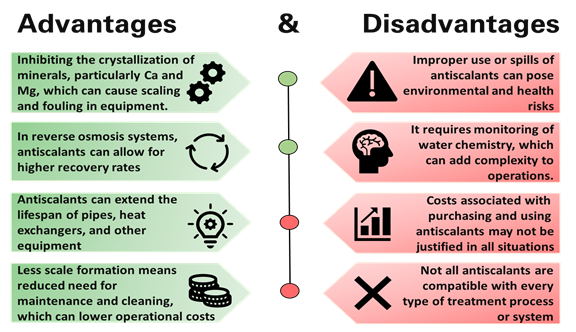
Antiscalants are essential in many industrial processes to control scale formation, enhancing equipment performance and longevity. By disrupting the mechanisms of scale formation through threshold inhibition, crystal growth inhibition, particle dispersion, and sequestration, they ensure efficient operation and reduced maintenance costs.